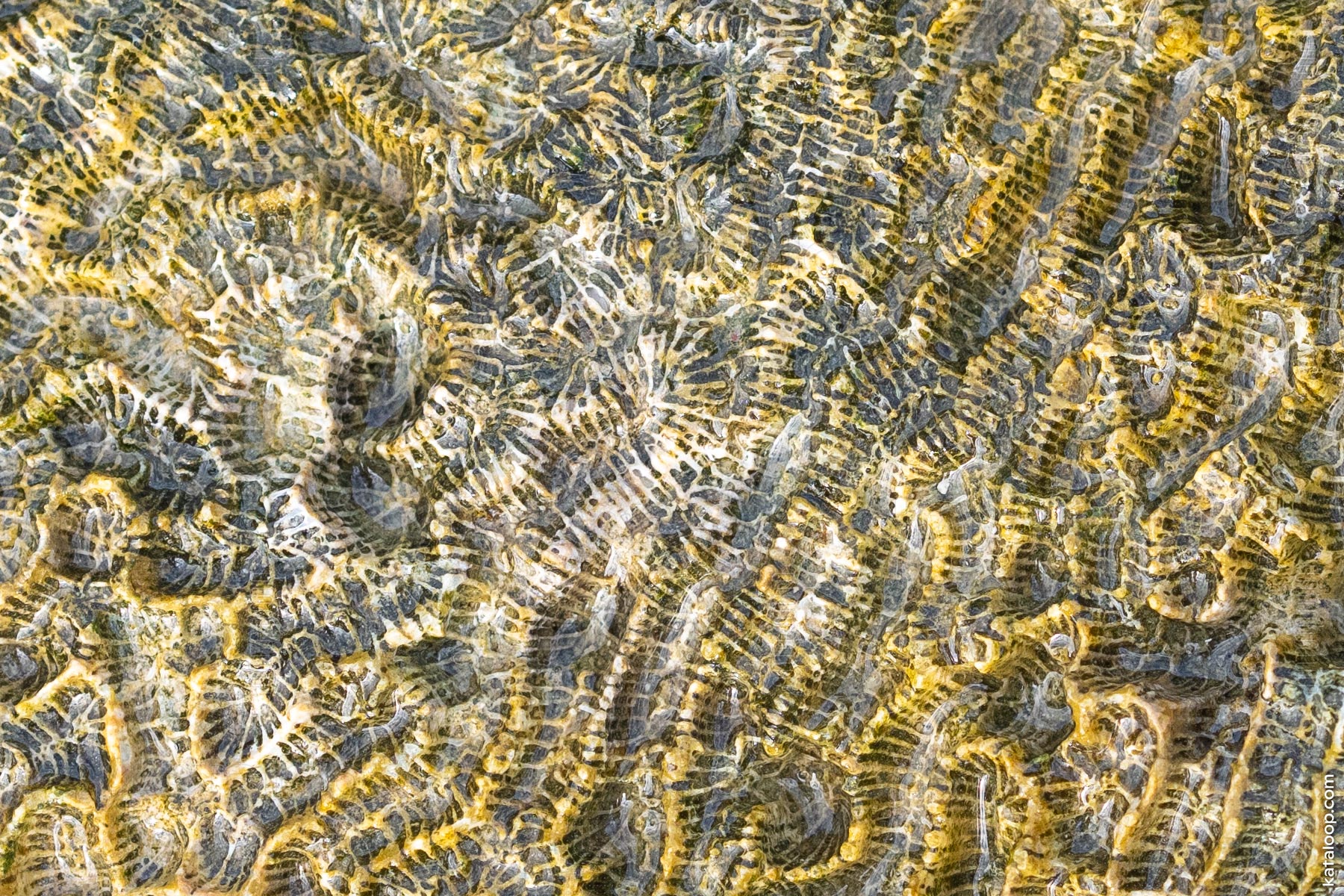
Close-up texture of brain coral fossil on rocky surface
Select your license:

Questions about the subject, usage, technology & more
How do brain coral fossils form and what do their maze-like patterns represent?
Brain coral fossils form when the calcium carbonate skeleton of colonial stony corals (family Mussidae or Merulinidae) is gradually replaced by minerals over millions of years. The distinctive winding ridges and valleys mirror the living coral's polyp rows and shared walls, preserving the colony's growth pattern in stone with remarkable fidelity.
How can this photo be used?
This stock photo is suitable, for example, for scientific publications, educational materials on paleontology and geology, as well as museums and e-learning platforms. Thanks to the commercial licensing available on Kataloop, it can also be used in conservation campaigns, geology-focused travel magazines, or as a background texture in design projects. The high resolution supports large-format printing.
What mood does this photo convey?
The image conveys a quiet, grounded heaviness. The contrast between the yellowish-golden fossil pattern and the dark gray rock creates an almost abstract effect. The winding ridges feel simultaneously alive and ancient, evoking associations with transience, natural history, and awe at geological timescales.
What equipment was used to capture this photo?
The intricate maze-like ridges of the brain coral fossil were captured with the Sony ILCE-1 paired with the Sony FE 85mm F1.4 GM. This 85mm prime lens delivers sharp detail rendition and shallow depth of field even at close distances. The Alpha 1's 50-megapixel sensor provides enough resolution for large-format print use, even when cropped.
What visual style or trend does this photo represent?
Nature-based textures and organic surface patterns are gaining traction in graphic design and brand communication as they convey authenticity and materiality. At the same time, topics like Earth history and biodiversity loss are entering public discourse, making images like this relevant for environmental and science communication. Visual complexity without digital post-processing aligns with the broader trend toward unfiltered authenticity.