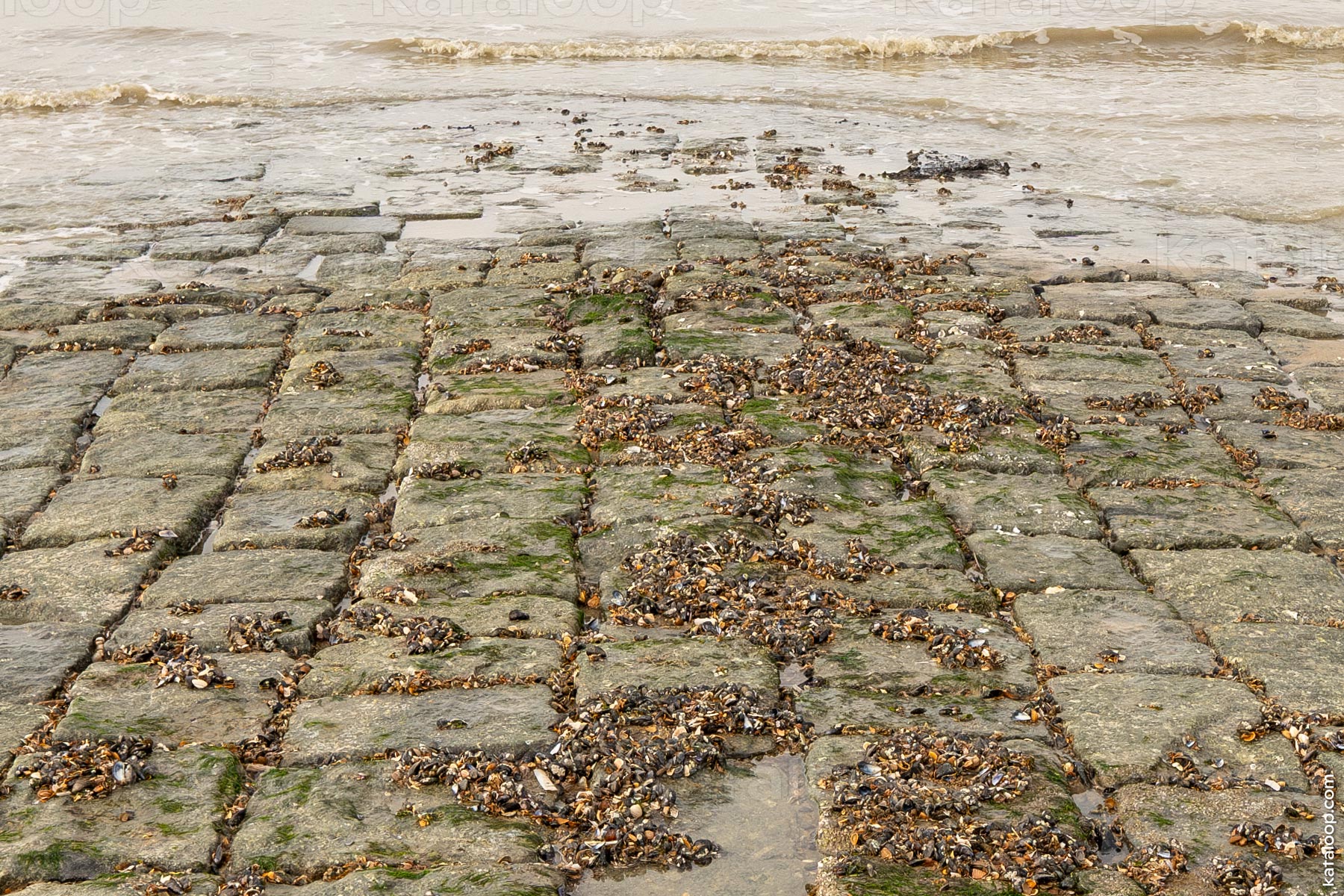
Seaside view with stone breakwater and accumulated shells
Select your license:

Questions about the subject, usage, technology & more
Why do mussels accumulate on stone breakwaters at the North Sea coast?
Mussels attach to hard substrates like stone breakwaters using thread-like structures called byssus. The rough, water-covered surface of groyne stones provides ideal conditions: stable anchorage, constant water flow, and abundant plankton. At low tide, clusters of mussels and shell fragments become visible, as seen on this breakwater near Cadzand in the Dutch province of Zeeland.
How can this photo be used?
Licensed commercially through Kataloop, this stock photo is well suited for campaigns on coastal protection, marine ecology, or climate adaptation, for example. Travel operators, conservation organizations, educational platforms, and print media focusing on the North Sea or Zeeland region can also take advantage of the 40+ megapixel resolution for large-format prints or digital placements.
What mood does this photo convey?
The central perspective of the breakwater leading into the calm sea creates a sense of stillness and open direction at once. The overcast sky and muted palette of gray, sandy beige, and olive brown feel sober and unadorned. The mussels and algae on the paving reference impermanence and the constant rhythm of the tides.
What equipment was used to capture this photo?
This shot was captured with the Sony Alpha 1 (ILCE-1) and the Sony FE 14mm F1.8 GM lens. The ultra-wide angle creates the striking leading line of the breakwater and conveys the spatial depth of the coastal structure. With a 50-megapixel sensor delivering 7751 x 5167 pixels, the Alpha 1 resolves fine details down to individual shell fragments and lichen between the stone joints.
What visual style or trend does this photo represent?
Authentic, unedited nature imagery is gaining traction in the stock photo market as brands increasingly turn to unposed environmental visuals. Coastal protection and marine ecology are socially relevant topics, making this photo a fitting visual anchor for sustainability communications, climate reporting, or ocean health campaigns.
Located on the North Sea coast of the Zeeland province, Cadzand-Bad is a Dutch seaside resort best known for its wide sandy beach and unspoiled coastal nature. As this photo illustrates, stone breakwaters define the shoreline and protect against erosion. The area attracts nature lovers, beachgoers, and photographers drawn to the quiet, expansive landscape overlooking the Scheldt estuary and the Belgian coast.